Mark Ling and Commission Cycle: Who Is Behind the 2026 Affiliate System?
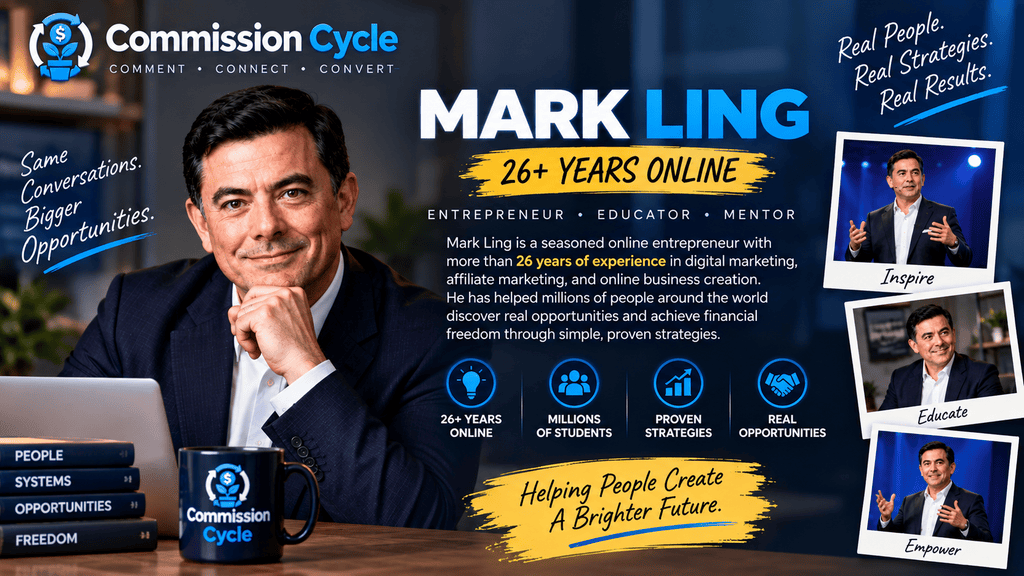
If you are researching Commission Cycle, understanding the person behind the program matters almost as much as understanding the training itself.
Mark Ling is the creator of Commission Cycle and a longtime online marketer whose career dates back to 1999.
Over more than two decades, he has worked across several generations of online traffic, from early search engines to Google, Facebook, YouTube, and newer social platforms such as Instagram.
That history is important because Commission Cycle is built around one of Mark’s central beliefs:
Traffic sources change. The underlying business model does not.
Commission Cycle is his attempt to package that thinking into a modern affiliate marketing system built around social traffic, one-word replies, automation, AI tools, and profit reinvestment.
Who Is Mark Ling?
Mark Ling is an affiliate marketer, online entrepreneur, educator, and product creator.
He began making money online in 1999, long before Instagram, YouTube, Facebook advertising, or modern AI tools existed.
That gives him more than 26 years of online marketing experience.
According to current Commission Cycle launch materials, Mark has adapted through roughly seven major traffic-source changes during that time.
Those traffic eras have included:
- early search engines,
- Google,
- Facebook,
- YouTube,
- Instagram,
- and other online traffic channels.
Here’s what most people don’t know: Mark does not present Commission Cycle as a strategy tied permanently to Instagram or one specific platform.
His wider point is that platforms change.
The marketer still needs to understand:
- where leads come from,
- how well those leads convert,
- how much each sale is worth,
- and how many times a customer buys.
Those business fundamentals sit underneath the current Commission Cycle strategy.
What Is Mark Ling Known For?
Mark Ling is particularly known for affiliate marketing education.
One of the businesses associated with him is Affilorama, a long-running affiliate marketing training platform.
His background also includes experience as:
- an affiliate,
- a product owner,
- an online marketer,
- an educator,
- and a business operator.
That combination matters.
Someone who has only ever taught affiliate marketing may understand the theory.
Someone who has also operated products, managed traffic, and worked with affiliates sees the business from more than one angle.
That broader perspective is visible inside Commission Cycle.
The program does not stop at:
“Find a product and promote it.”
Instead, it looks at the full system around traffic, conversion, customer value, and reinvestment.
What Is Mark Ling’s Commission Cycle?
Commission Cycle is Mark Ling’s 2026 affiliate marketing system.
The method is built around four stages:
Attract → Convert → Ascend → Compound
Attract
Use social content to generate attention from people who may be interested in a particular problem or offer.
Convert
Turn that attention into conversations, leads, or relevant affiliate recommendations.
Ascend
Increase the value of the customer relationship through suitable next-step offers.
Compound
Reinvest part of the commissions into growing the business further.
Then the process starts again.
In simple terms:
Traffic → Conversation → Sale → Commission → Reinvestment → More Traffic
That loop is the core idea behind the name Commission Cycle.
Why Does Mark Focus on One-Word Replies?
One of the most distinctive ideas in the current Commission Cycle training is the one-word reply strategy.
Instead of focusing entirely on views and likes, Mark encourages content that gets people to actively respond.
For example, a social post may invite someone to comment:
INFO
START
or
GUIDE
That small action shows more intent than a passive view.
A viewer who comments is effectively saying:
“I want to know more.”
That creates an opportunity for a conversation.
Automation can then help deliver a resource, follow up, or move the person toward a relevant affiliate offer.
The idea is simple, but it changes the focus from vanity metrics to buyer intent.
Why Mark Ling Uses AI and Automation
Modern social marketing can be time-consuming.
Researching content, writing scripts, creating posts, producing images, making videos, and replying to people can quickly become overwhelming for one person.
Commission Cycle uses AI-assisted tools designed to reduce that workload.
According to the current program material, tools can assist with:
- research,
- scripts,
- social posts,
- images,
- videos,
- and other content tasks.
Automation can also help with conversations generated from social comments.
To be honest, this does not mean the business becomes fully passive.
AI can save time.
Automation can reduce repetition.
But the marketer still has to choose offers, understand the audience, track results, and make decisions.
That distinction is important.
What Niches Does Mark Ling Focus On?
Mark currently emphasizes two main markets inside Commission Cycle:
Personal Development
This includes a wide range of subtopics and product opportunities.
Make Money Online / Internet Marketing
This includes affiliate marketing, online business, marketing tools, software, traffic, and digital training.
Mark also teaches the idea of moving between these two markets where there is natural audience overlap.
For example, someone interested in productivity or mindset may also be interested in creating an online income stream.
That crossover can create additional affiliate opportunities.
What About the $400 Million Student Sales Claim?
Current Commission Cycle promotional material states that people Mark Ling has taught have generated more than $400 million in sales through ClickBank.
That is a significant number, but it needs context.
It refers to aggregate historical sales generated by people Mark has taught across previous programs and years.
It does not mean:
- Commission Cycle itself generated $400 million,
- every student was successful,
- a new Commission Cycle buyer will earn a specific amount,
- or the average student achieved extraordinary results.
Historical student sales are not the same thing as guaranteed future earnings.
That distinction should always be kept clear.
Why Mark Ling’s Experience Matters
Experience alone does not automatically make a training program valuable.
A person can work online for 20 years and still teach outdated ideas.
What makes Mark’s background relevant is that his core argument is built around adapting to change.
He has seen traffic platforms come and go.
The current Commission Cycle strategy uses Instagram, YouTube, AI tools, and automation because those are relevant today.
But the deeper model is not supposed to depend on those tools forever.
Mark’s philosophy is essentially:
Use the traffic source that works now, but build around business fundamentals that survive platform changes.
That is a more durable idea than simply chasing the latest algorithm trick.
Is Mark Ling’s Commission Cycle Worth Exploring?
If you are interested in affiliate marketing, social traffic, and automation, Commission Cycle may be worth investigating.
The program is currently priced at $2,497, so I would not recommend making a rushed decision.
Mark offers free educational material connected to the launch, including:
- Profit Engine Live
- The Backwards 4-Step Cycle Report
These resources give you a chance to see how he teaches and how the system works before considering the premium program.
Final Thoughts on Mark Ling and Commission Cycle
Mark Ling’s biggest advantage is not simply that he has been online since 1999.
It is that he has worked through repeated changes in traffic while maintaining the same underlying focus on business economics.
Commission Cycle reflects that philosophy.
The current tactics involve:
Instagram. YouTube. One-word replies. AI. Automation.
The deeper framework remains:
Attract. Convert. Ascend. Compound.
That is the real connection between Mark Ling and Commission Cycle.
If you are considering the program, study the free material first, understand the business model, and then decide whether Mark’s approach matches how you want to build an affiliate business.